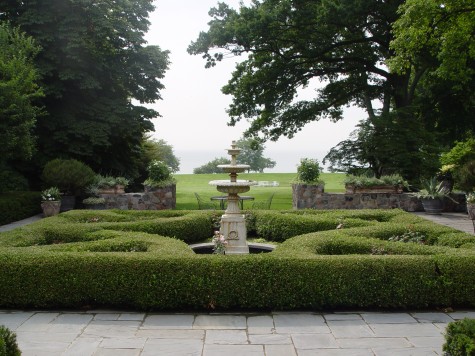
 In my last essay, I spoke to the importance of determining what you need from your landscape. This informs a new landscape, a landscape project, or a landscape renovation. This client has been a client a good many years. The boxwood parterre planted in the center of a bluestone terrace began life as plants just 15 inches tall. A central fountain pool featured a small sculpture. The landscape has changed a lot over the past 20 years. Some years ago, the stone walls and planters at the far end of the terrace were installed based on a visit my client made to South America. The fountain sculpture was replaced some years later by a very fine 19th century American cast iron fountain. There were changes afoot. All during this time, the boxwood was growing.
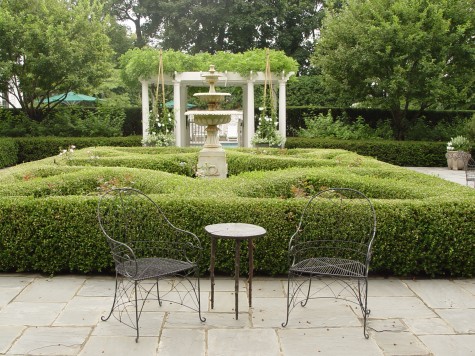 At a certain point, this boxwood parterre had grown so large that the roses began to struggle. As I have said before, a landscape never comes to maturity and stands pat. Equality, stasis in the garden-not likely. The strength of every element ebbs and flows-given the moment and circumstance. That fluid community that loosely describes a landscape involves a great number of relationships that are always changing. This part thrives and grows, at the expense of some other part. A giant tree can pass away, leaving an entire garden community below wringing its hands.
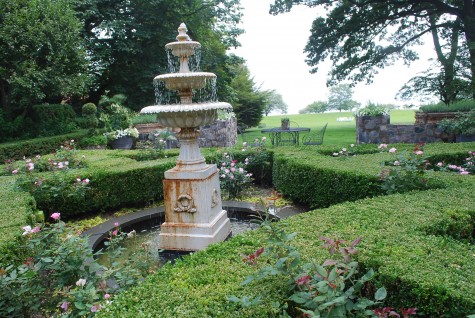 This beautiful 19th century American cast iron fountain was perfect for this landscape, but much overscaled, and much too important for the existing pool. My client has a great eye, and thinks things through thoroughly. Her strength vis a vis the landscape is an ability to plan for the future-one great move at a time. Last summer, she let me know that the boxwood parterres, grown way out of bounds, had greatly diminished her available terrace space. She was ready to make a change. Elements in a landscape have a lifespan.
 I think I am a good designer, but I would be telling you a tale if I were to say I designed on my own. My clients say things, point out this or that-they enable me to design in a meaningful way. They look at and live with that garden every day. A designer whose pet look is evident in every project-in my mind, a failure. Great design is about the results of a relationship, a conversation. My client knew better than I that the boxwood parterre had peaked-what would I suggest?
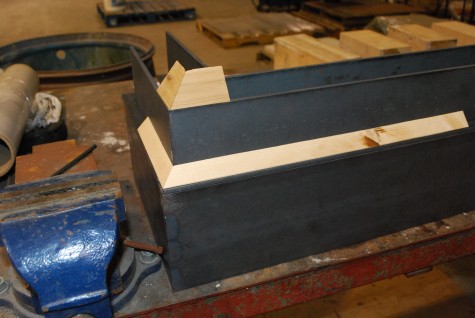 It was agreed that a larger fountain pool would better do justice to her lovely fountain. I did manage to persuade her that a properly porportioned surround for her beautiful American fountain should be steel, and finished with degraded paint. The fountain, and pool surround-we could suggest visually that both elements came together. Some of the details of that surround we engineered in wood, and sent out to a skilled machinist to make. The steel pool surround weighs just about one ton.
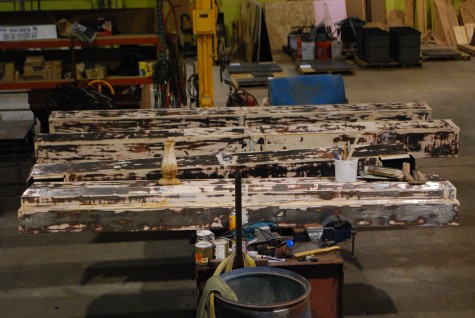 The paint finish was another story. I primed the steel. I sanded the primer off irregularly. I was interested in obtaining a reasonable reproduction of old paint.
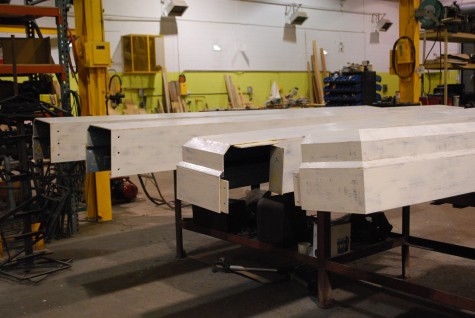 The final paint surface in the studio looked uniformly cream colored, butI knew the winter weather would work its magic.
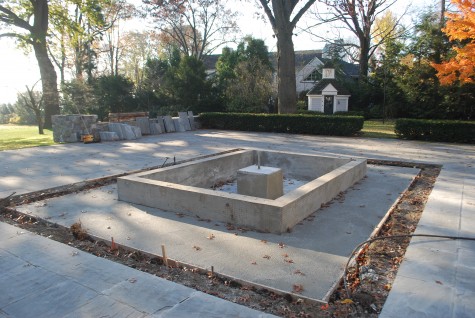
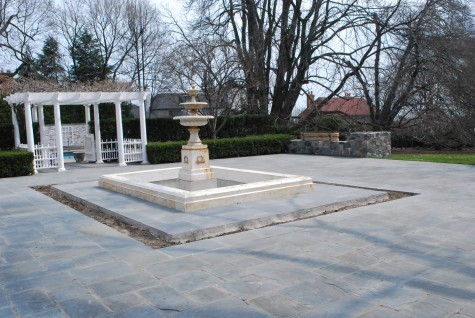 The boxwood parterre so long a fixture of this landscape is gone. The terrace has that spacious feeling back again. The fountain pool was poured 18 inches below grade; that portion of the pool, and the concrete pedestal for the fountain will be coated with black pool paint. This will make the water surface reflective. There is a plan for water lilies in the pool. One the pots are put out and planted, and the furniture in place, the renovation will be complete.
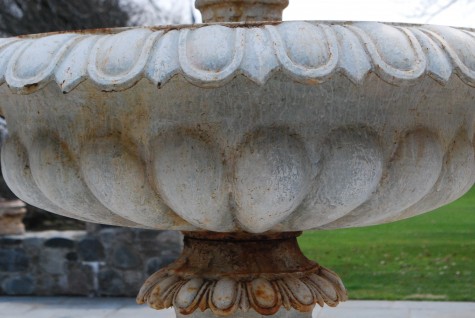 The fountain surround will get a final paint finish emphasizing the soft grey and cream color you see here on the bowl.
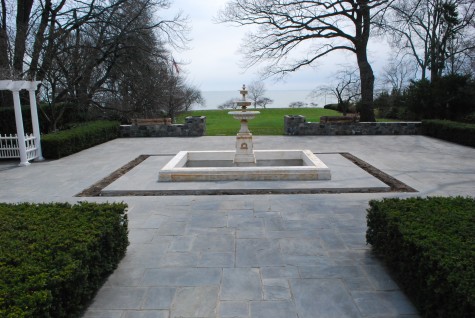
The last detail-the dark frame you see in the above picture. A large terrace, or even a driveway, can benefit visually from a change in materials that breaks up the space in an interesting way. A detail like this also serves to separate the brand new stone surface next to the fountain pool from the original stone. This deters the eye from making comparisons. In this regard I need not have worried; Albaugh Masonry did a superb job of making what was new look very much like the original. After I fill this frame with dirt, I am thinking of planting a very low growing plant that would tolerate foot traffic-perhaps Isotoma Fluvialis. Other choices could be just as good looking. This moment in a project is such fun.